
The Rise of Evidence-Based Oversight in Australia
Governance in Aussie financial services is changing.
For many years, organisations have relied on documented policies, periodic reviews and management reporting to demonstrate that risks were being managed appropriately. Those foundations remain important, but they are no longer sufficient on their own.
Across the industry, there is a growing expectation that organisations should not only have robust governance frameworks, but also be able to demonstrate that those frameworks are operating effectively every day.
This is the rise of evidence-based oversight.
Recent developments across the Australian financial services landscape all point in the same direction. APRA's CPS 230 has strengthened expectations around operational resilience and the oversight of critical service providers. ASIC has continued to highlight weaknesses in governance and operational controls, while industry guidance such as the Financial Services Council's Standard 31 places greater emphasis on ongoing monitoring, documented decision-making and demonstrable oversight.
Although these developments address different parts of the industry, they share a common theme.
Good governance is no longer measured by the number of policies an organisation has. It is increasingly measured by the evidence that those policies are operating as intended.
The question is no longer, "Do we have a control?"
The question is, "Can we demonstrate that the control was performed, that exceptions were identified and investigated, and that appropriate action was taken?"
From Policies to Proof
Financial services organisations operate in increasingly complex environments.
Fund administrators, custodians, investment managers, pricing vendors, technology providers and other specialist partners all play critical roles in delivering investment products and services. While many operational activities are delegated, accountability remains with the trustee, responsible entity or regulated organisation.
This creates a new governance challenge.
How do organisations gain confidence that controls are operating effectively across multiple internal teams and third-party providers? Historically, the answer has often been through spreadsheets, email chains, meeting minutes, manual reviews and periodic reporting. These approaches can demonstrate that a review took place.
They do not always demonstrate that risks were identified early, that controls operated consistently or that emerging issues were escalated before they became significant.
Continuous Oversight
The industry's operating model has changed.
Governance needs to evolve alongside it. Rather than relying solely on periodic reviews, organisations are increasingly moving towards continuous oversight.
-
Instead of sampling a small proportion of activity each month, technology allows controls to be performed across complete datasets.
-
Instead of waiting for management reports to identify emerging issues, exceptions can be identified as they occur.
-
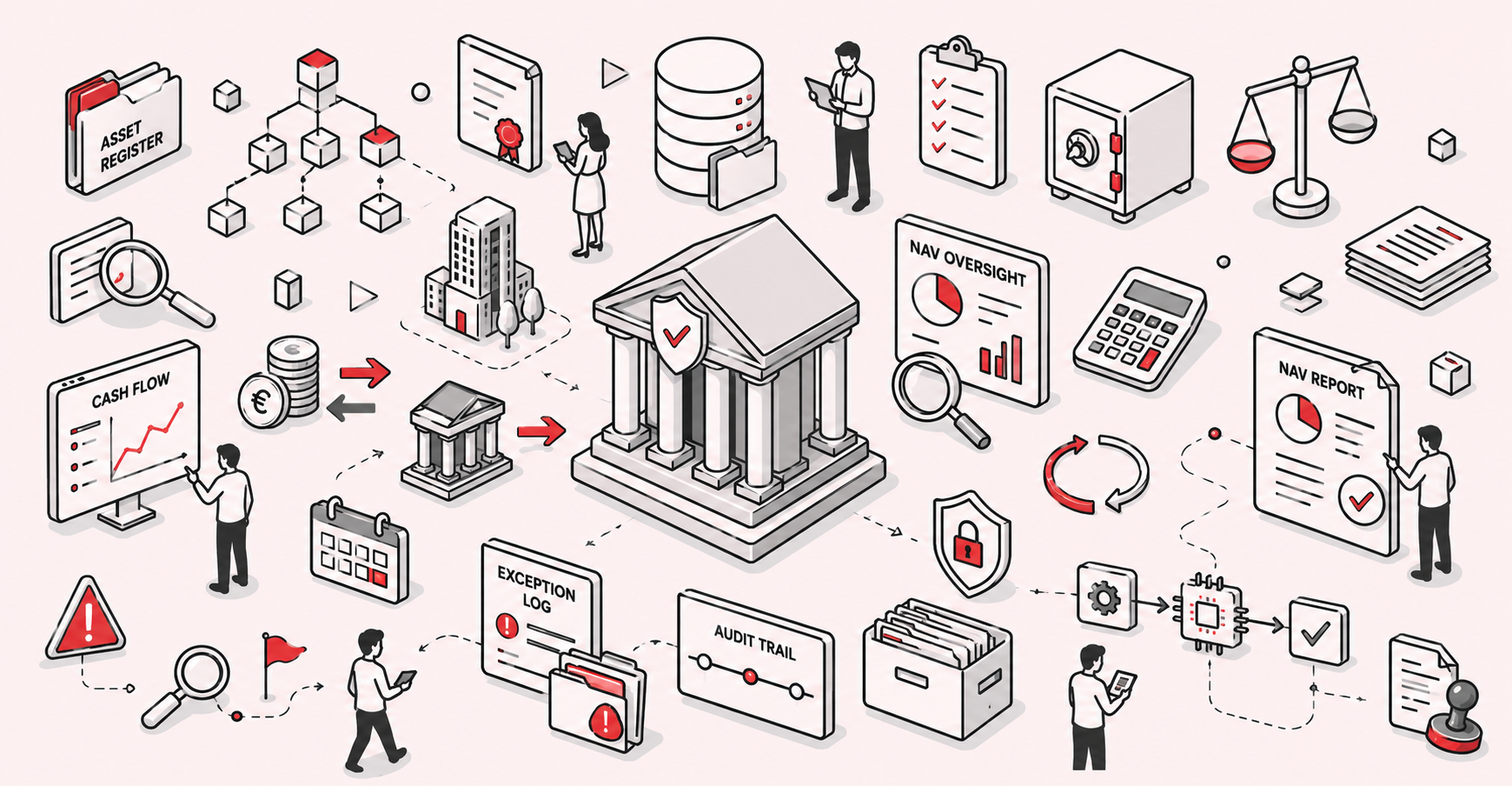
Instead of relying on fragmented evidence stored across spreadsheets, email and collaboration tools, organisations can create a structured and auditable record of oversight activities.
This changes the role of operational teams. Their expertise is no longer consumed by manually searching for issues. Instead, it is focused on investigating exceptions, exercising judgement and managing risk.
Technology does not replace governance.
It strengthens it.
Why This Matters
Evidence-based oversight delivers benefits far beyond regulatory compliance.
-
It improves operational resilience.
-
It reduces reliance on key individuals.
-
It strengthens governance reporting.
-
It creates greater transparency across internal operations and outsourced service providers.
Most importantly, it gives organisations confidence that critical controls are operating as intended, rather than assuming they are. As operating models continue to become more complex, that confidence becomes increasingly valuable.
Looking Ahead
The direction of travel across financial services is becoming increasingly clear.
-
Governance is evolving from periodic review towards continuous oversight.
-
From manual processes towards structured workflows.
-
From fragmented information towards independent validation.
-
From assumption towards evidence.
At Fund Recs, we believe technology has an important role to play in enabling this evolution. By automating operational controls, independently validating critical processes and surfacing exceptions that require investigation, organisations can strengthen governance while allowing experienced teams to focus on the decisions that matter most.
The future of governance is not about performing more checks.
It is about performing the right checks, at the right time, with the evidence to demonstrate they are working.